Post-Rose Revolution Architecture in Georgia
Mariam Natroshvili
Mariam Natroshvili (1987) and Detu Jincharadze are artists based in Tbilisi, Georgia. Natroshvili holds a Master’s degree in Social Sciences, while Jincharadze holds a Master’s degree in Architecture. They have been working together since 2011. The duo works across text-based art, archival and CGI video, and digital interactive experiences. Collecting oral histories is central to their practice.
Their work explores how forgotten and suppressed pasts continue to shape the present. Their interests include the Soviet past and post-Soviet transformations, as well as folk beliefs and their influence on contemporary everyday life. Mariam and Detu often use places, buildings, and objects as tools for examining history and telling stories through them. Their practice also engages with the histories of art in Georgia.
Natroshvili and Jincharadze’s work has been exhibited internationally, including at IDFA DocLab, the Gwangju GMAP Facade Project, the Sinop Biennial, and the Porto Photography Biennial, among others. In 2022, they represented Georgia at the 59th Venice Biennale with I Pity the Garden, a large-scale video and VR installation. Their text-based installations have been presented in public spaces in Tbilisi and other cities. Mariam is the author of the book Excerpts: From the History of Georgian Media Art.
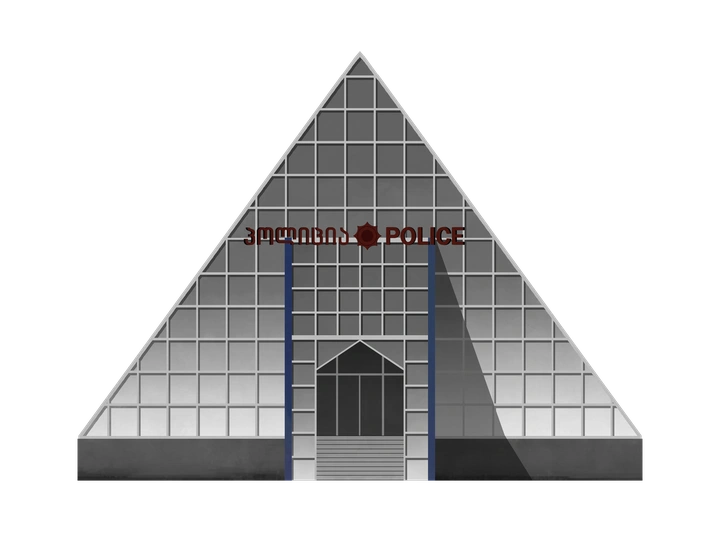
After the Rose Revolution, Georgia entered a period of rapid political and social transformation. The new government began reforming post-Soviet public institutions that were widely perceived as corrupt. Transparency became one of the central ideas of these reforms, and this concept was reflected in architecture. One of the first waves of construction were transparent glass police stations, followed by other public buildings, including the Music Theatre and Exhibition Centre designed by Massimiliano Fuksas.
Located in Tbilisi’s historic district, the Music Theatre and Exhibition Centre is currently being demolished. The building, along with the Bridge of Peace and other architectural projects, had become associated with former president Mikheil Saakashvili’s political legacy and style of governance. The building remained unused for years and fourteen years after coming to power, the Georgian Dream government fulfilled its promise to demolish the structure.
What do these buildings reveal about the political imagination of that period? And how do these structures function today, after the political context that produced them has changed?
This project aims to explore Rose Revolution-era architecture in Georgia as an archive of political and social transformation. It investigates buildings created during this period, asking what remains of these architectural promises today. The project examines buildings as political documents - spaces where ideology, memory, aspiration, and failure become visible.
Combining archival materials, observations, and oral histories, the project proposes an alternative reading of recent Georgian architectural history.
This idea emerged while developing Tbilisi Guide, an app that explores architecture as an archive of Tbilisi’s post-Soviet transformation. This research could further develop into a sound walk or documentary film that explores these architectural sites and their changing meanings within the city.