Playing In-Between
Mariana Abreu (1998, Portugal) is an architect and independent researcher. She holds a Master’s degree in Architecture from the Faculty of Architecture of the University of Porto. Her professional path includes collaborations with Architecture Offices in Amsterdam, Lisbon and Braga. Mariana is currently developing an interdisciplinary practice at the intersection of architecture, education and participatory methodologies. She is an educational mediator and founder of Brinca que Brinca, an initiative that brings architecture closer to children through play, experimentation, and spatial transformation. Her work is based on collaborations with schools, municipalities, parish councils, museums and cultural institutions. She sees architecture as both an educational tool and a process of collective making.
As a response to the housing crisis, urban development and architecture have prioritised construction and efficiency, often overlooking the potential of undefined spaces that enable encounter, appropriation and play. As urban life has moved upwards, children have gradually disappeared from the street, while play has retreated into controlled and specialised environments. In addressing one crisis, we may have intensified another - the erosion of everyday community life.
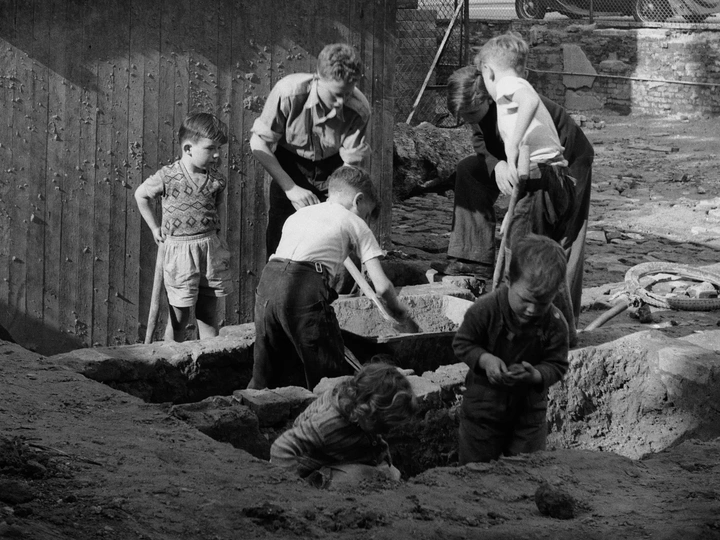
Children are not merely users of the city, they are active producers of space. Through play, they explore, appropriate and reinterpret their surroundings, revealing spatial possibilities that architecture frequently forgets. Rather than asking how cities can be designed for children, this project asks what architecture can learn from children's natural spatial practices and how it can play a role in reviving a sense of community in today’s cities.
As a neighbourhood-scale festival and research platform, Playing In-Between activates public space and collective housing as a shared field of spatial inquiry. It understands play as an architectural method: a way of reading the city through children's imagination, and invites children, residents, architects and local communities to rediscover and redesign the overlooked spaces of everyday life. As cities continue to grow vertically, perhaps new streets may emerge in layers, in corridors, terraces, landings and shared thresholds. The residual or transitional areas may be transformed into places where new forms of encounter, belonging and collective life can emerge within increasingly dense urban environments.
From designing for children, this project proposes designing with them. It recognises children as co-authors of space. By learning from the ways they perceive, appropriate and transform their environments, the project advocates a more inclusive, imaginative and community-oriented approach to shaping the city.