Cosmic Heritage in the Ararat Valley
Juliette Martin
Anahit Ghazaryan and Juliette Martin have worked together since 2024 on projects concerned with architecture, heritage and memory. In 2025 they produced Playground — Evci-Evci — Toun-Tounique, an installation for the conference Echoes and Futures: South Caucasus in a Shifting World, curated by the Center for Independent Social Research in Berlin, with Meri Karapetyan and an anonymous Azerbaijani artist.
Anahit Ghazaryan is a writer, visual artist and filmmaker based in Yerevan. Her work is driven by questions of memory, identity and gender-based justice, with particular attention to how women's lives and images are shaped, preserved or erased in Armenian and post-Soviet contexts. Working with archives, found images, interviews and long-term research, she treats the archive not as a fixed repository but as a site of resistance and re-imagination, using reversal, re-editing and re-contextualisation to examine how visual histories are constructed and how inherited narratives can be rewritten. Across text, audio, photography, documentary theatre and film, she works with silenced voices and overlooked histories, often through collaborative authorship. In her practice, remembering is a political act.
Juliette Martin is a French architect and researcher working at the intersection of architecture, archaeology and territory. She studied architecture at ETH Zurich and is based in Switzerland. She is researcher and Studio Director at the ALICE Laboratory, EPFL, leading a collective mapping studio in a UNESCO context. Between 2023 and 2025 she contributed to the Vedi River Valley project at the University of Hong Kong, in a research team led by Guillaume Othenin-Girard, developing survey and mapping methodologies for its archaeological landscape. She runs Studio Juliette Martin, specialising in digital forensic documentation and design in context, and co-founded RealityWorks KLG, working on image, film and spatial media production for architecture and adjacent fields.
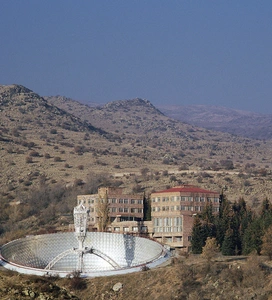
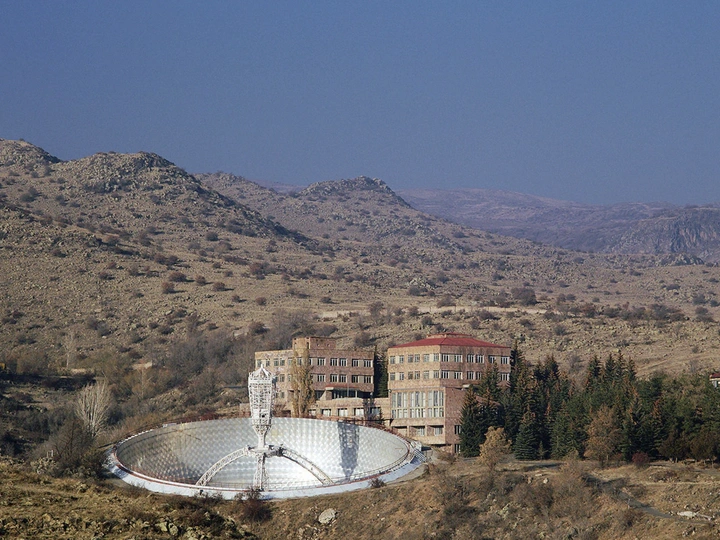
The Armenian Highlands are scattered with Soviet-era astronomical instruments: objects at the scale of architecture. Conceived at the height of the Soviet space programme, they materialized a profound optimism: a conviction that even peripheral territories could produce universal knowledge, fixing an imagined future onto the land itself.
Yet the future imagined by those structures never arrived. With the collapse of the Soviet Union, the horizon that produced them disappeared, leaving these constructions suspended in the landscape, orphaned materializations of ideas that no longer belong to the present. Most remain absent from public memory, quietly dissolving into the territory they were meant to transform.
Today, as the climate crisis deepens and the valley's hydrological regime fails, everyday life depends on an ageing Soviet canal network that rations water for agriculture and domestic use.From above, a line is legible: a narrow, endangered green plain beneath the canal's horizon, above it a dry steppe stretching to the summits, where fieldwork led us to an undocumented cosmic ruin, still pointed at the sky. Up there, a European mission trains astronauts on Mars's closest geological analogue, a resemblance drought is making literal.The film explores the tension between these two realities at two altitudes.
Developed through a collaboration emerging from the Drawing into Place archaeological research in the Vedi Valley, the film brings together architectural survey, territorial analysis, archival research, oral history and a research-based artistic practice working through text and testimony.Documentary in method and essayistic in form, it traces overlapping temporalities: forgotten cosmic ambitions, fragile infrastructures of survival, and a landscape repeatedly asked to carry visions of the future. Rather than reconstructing a hidden history, it asks what it means to inherit futures that no longer belong to us, while a different future is already unfolding.