Looking for What Is Left
Beatrice Bucher
Based in Stuttgart, we have been working together since 2024, brought together by a shared interest in how spaces are shaped by social, ecological, and material networks. Both of us are also part of the collective Neckarinsel, where we explore how water landscapes can be transformed through co-productive processes involving different actors, forms of knowledge, and local perspectives.
In times of ecological urgencies we share an instinct to initiate projects whenever we encounter social or spatial needs that remain unaddressed. Our practice is therefore shaped by a critical engagement with established structures, a strong commitment to collective ways of working, and a consistently interdisciplinary approach. The methodology of collecting is an important part of our design process. We gather objects, stories, references, and spatial traces as a way of understanding a context and identifying overlooked connections, unresolved questions, or gaps in existing discourse.
As spatial designers, we work with an expanded understanding of architecture that moves beyond the conventional distinction between interior and exterior. Rather than treating architecture as an autonomous object, we understand spatial design as a collaborative, situated, and systemic process. Our practice operates across spatial research, object-making, exhibitions, workshops, teaching, and curatorial work, allowing different methods, perspectives, and forms of knowledge to inform one another.
Beatrice’s work focuses particularly on co-production, exhibition-making, and spatial experimentation. Her approach explores how spaces can become platforms for exchange, participation, and collective learning. Patrick works through research-based design and small-scale interventions that critically reflect on our built and natural environments. Together, these perspectives form a practice that combines critical inquiry with hands-on experimentation and collaborative spatial production.
Looking for What Is Left is an ongoing spatial research project that examines the material remains of architecture and the extractive systems on which architectural practice depends. We understand architecture not as an isolated or finished object, but as part of broader ecological, social, and economic processes of extraction, production, use, demolition, and reuse.
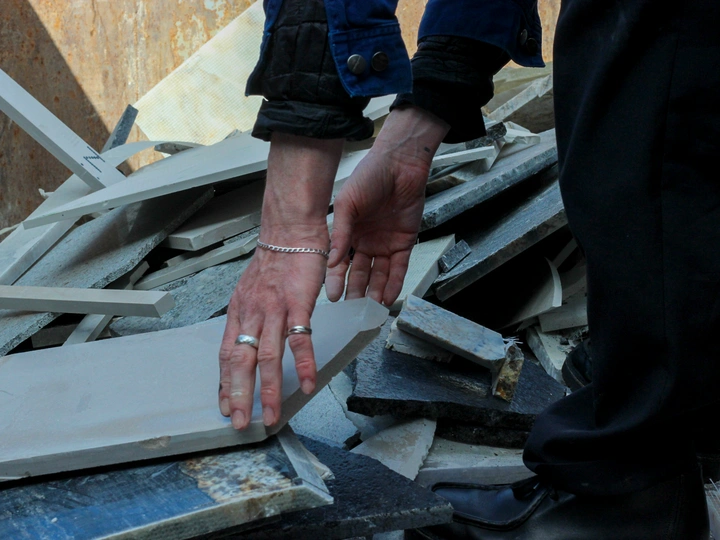
Building on Patrick’s existing project, we aim to further develop and expand our methodology of collecting, tracing, connecting, and rearranging. We will work with fragments and residues from construction, demolition, and industrial production, while examining the ecological, political, and social networks in which they are embedded. Material experiments will be combined with field research, conversations with workers and local communities, mapping, writing, and photographic documentation.
We understand material as a temporarily stabilised and capitalised state of matter—a brief moment within a much longer process. Matter includes not only what is considered architecturally valuable or usable, but also dust, residues, fragments, and waste.
The idea is to extend this approach beyond stone and respond to locally available materials, waste streams, and specific spatial conditions. Depending on the context, the research may develop into a series of objects, installations, collective mappings, or other site-responsive collective formats. Found elements will remain largely unaltered and will be assembled through temporary, reversible connections.
We are particularly interested in developing the project through co-production. Teaching formats and workshops could bring together students, local communities, craftspeople, workers, and researchers to collect, document, and reinterpret material remains. In this way, collecting becomes not only an artistic method, but a shared form of spatial inquiry through which material histories, local knowledge, and alternative forms of reuse can be explored collectively.