Performing the Pannonian Porch
Stanislava Predojević
We are a multidisciplinary team combining spatial research, history, architecture and design. We believe that local knowledge and collective intelligence are essential to address the challenges of our time. We are passionate about researching, practising and educating others in built heritage and the urban palimpsest. Our projects include curatorial and design proposals such as 'Gonk: A Threshold in Space, Time, and Culture' for the Serbian Pavilion at the 2025 Venice Architecture Biennale, and 'Memorial to the Dead Fish' for Architekturwochen Basel 2024.
Stanislava Predojević is a Serbian architect and urban planner. Growing up in the multicultural landscape of Vojvodina and studying in Belgrade and at ETH Zurich shaped her interest in architecture as a mediator between culture, territory, and social change. After more than a decade in architectural practice, she now works on large-scale urban transformation for the City of Basel. She has taught in Belgrade and Karlsruhe and contributed to competitions and exhibitions. Through summer schools and Basel-based associations, she promotes contemporary building culture. Her work connects design, research, and public engagement, exploring architecture as a cultural practice shaped by place, memory, and urban transformation.
Patrick Düblin is a Swiss urban researcher and spatial practitioner whose work encompasses walking-based urban research, participatory spatial practice, and critical studies of the built environment. He studied art history and philosophy in Basel and Berlin and completed a PhD in Architecture at ETH Zurich, focusing on performative and socially engaged spatial practices. Building on his experience of teaching psychogeographical interventions, he founded the Office for Peripatetic Design in 2025, an informal agency offering public excursions into everyday urban spaces. He has published books, curated exhibitions and developed educational programmes focusing on art, urbanism and spatial practice.
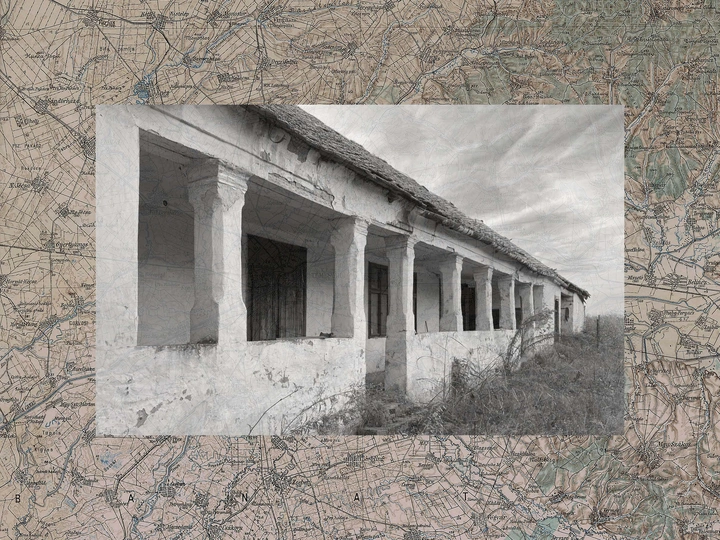
In times of crisis, built heritage can help communities reconnect and live more sustainably. Traditional longhouses built using local materials and craftsmanship are a recurring phenomenon in the border area between Hungary, Romania and Serbia. A key feature of these late Habsburg-era buildings is the porch or gallery spanning the entire long side. Depending on the region, its name varies: ‘trem’ in Serbian, ‘tornác’ in Hungarian, ‘prispă’ in Romanian. Other terms (such as 'gang', 'gonk') echo the German word 'Laubengang'. This linguistic diversity reflects the southern Pannonian basin as a melting pot of cultures. Our aim is to invite residents to perform on what we call the Pannonian Porch.
While there is little documentation on the original use of these transitional spaces, we see them as fertile ground for current use. The project has three intertwined goals: (1) actively experimenting with how residents use the porch; (2) raising awareness of the buildings’ cultural heritage, fragility and potential; and (3) fostering identity and knowledge exchange across state borders. By performing the Pannonian Porch, we elevate it beyond a mere architectural element to become a method, a metaphor and a manifesto.
Building on previous research, we will launch a public call inviting residents to gather on their porches and engage in festive and hospitable activities. This collaborative social experiment will map these houses and create an archive of contemporary Pannonian Porch use.
The project is scalable. The gathered material could be used to create an online platform, publication or exhibition. However, the main objective is to organise a 'Public Porch Day' to raise awareness and stimulate public debate. Our long‑standing fascination with these buildings – and concern about their neglected state – has already informed a proposal for an architecture biennale. Through LINA, we aim to extend our work by establishing a transregional network of Pannonian Porch practices.