Mise le Meas
Stephen Landy
Paul Stewart
Dawna began as a group of friends from architecture college in Dublin publishing a zine about what we saw as a lack of public engagement on architecture culture in Ireland. Since graduating, we have each pursued creative careers in architecture and the arts between Dublin, London and New York. Together, we curated and designed the group exhibition Mise le Meas as part of Open House Dublin 2025, exploring contemporary emigration through an emotional lens of architecture. Each of the three members specialise in a specific medium: writing, drawing, and filmmaking. This inter-disciplinary approach allows us to connect with the public in an approachable and evocative format.
Paul Stewart is a writer and conservation architect based between London and Dublin interested in collective ways of organising the city and creating narratives of hope. Their writings on squatting, urban vacancy, and architectural memory have been exhibited for Open House Dublin (2024, 2025), and been published by architecture publications Type (2024) and Crumble Magazine (2026), and literary magazine Mnemotope (2026).
Stephen Landy is a video journalist and storyteller based in New York City exploring how architecture and placemaking can restore community in an era of social fragmentation. He has covered Milano Design Week (2023) and the Venice Architecture Biennale (2023) for designboom, and co-founded third place (2026) with Manhattan Neighbourhood Network, a media and events platform connecting digital engagement with civic participation.
Aoife Casey is a practicing architect based in London. Her work is most interested in visual storytelling, bridging hand drawing with critical research to unfold provocative thoughts or detail untold narratives. Most recently her work has been exhibited at the 195th Royal Hibernian Academy Summer Show (2025) and her drawing was selected for Open House Europe’s Visual stories competition (2025).
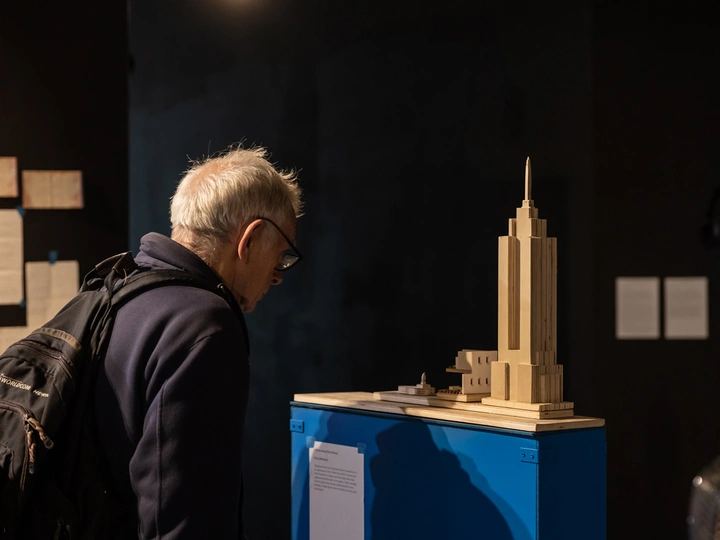
Mise le Meas (yours sincerely in Irish) investigated the emotional effects of emigration on the city of Dublin. We gathered a group of young artists, architects, musicians, and filmmakers who have all left Dublin for creative opportunities abroad and commissioned them to produce an exploratory piece on their experiences through the lens of architecture. These pieces, along with a collection of letters and public response sheets, were exhibited during Open House Dublin 2025.
The work was made in response to the high levels of emigration of young adults which is being spatially accelerated by a lack of housing, cultural infrastructure, and public space. As three graduates who left Dublin for London and New York, we sought to represent our collective absence in a physical space to question the potential loss of our future heritage in the city.
The curatorial lens encouraged work made in an emotive yet critical register expressing the fragmented experience of city life under globalised conditions of nomadism and disorientation; in this way it sought to challenge the inequities of urban development by amplifying voices affected by it.
The design took the form of three temporal narratives: the past was explored by letters that reflected on reasons to leave; the present by commissioned pieces of drawing, film, model, and music that texturally explored old spaces and new; the future was probed by response sheets that gave the public a chance to respond to the content. The responses were elaborated upon at a lively open-table discussion we hosted in the space on the theme diaspora, where we heard views from local people on how the city might develop sustainably to nurture its people instead of dispelling them. Invoking the public into passionate debate on what future Dublin we might inhabit was for us the most successful element. Building on this, we wish to develop further situations where the emotional gap between architecture and public can be bridged.