Echoes of a Buried River
I am an architect and urban planner working across design, urban research, and sustainable transformation of the built environment. My practice focuses on understanding how architecture can respond to cultural and ecological challenges while strengthening the relationship between people and places.
I have experience working on projects at scales from interior and architectural design to urban strategies and spatial planning. Through my work and academic research, I have explored themes of public space, urban regeneration, historical layers of cities, and the role of memory in shaping contemporary environments.
I have collaborated on planning and research projects in Georgia and abroad, including work on strategic visions, analytical studies, and participatory processes. During my involvement in the development of the general plan vision for Borjomi, I contributed to field research, spatial analysis, sociological studies, and documentation of the city’s heritage. I have also participated in workshops, including Les Ateliers de Cergy, where I worked with an interdisciplinary team exploring ecological approaches and new relationships between territories and landscapes.
My academic interests are closely connected to the transformation of cities and the search for resilient and inclusive urban environments. I am particularly interested in how overlooked spaces, historical narratives and natural systems can inform architectural approaches.
Alongside my research practice, I work on architectural and interior projects exploring materiality, atmosphere and the creation of meaningful everyday spaces. I believe that architecture is not about producing objects but about revealing connections between culture, nature and human experience.
Cities are shaped not only by what is visible but also by what has disappeared. Beneath Tbilisi lies a network of rivers and streams that once structured the city’s landscape and everyday life. Today, many of these waterways continue to flow through artificial channels, yet they have gradually vanished from public awareness.
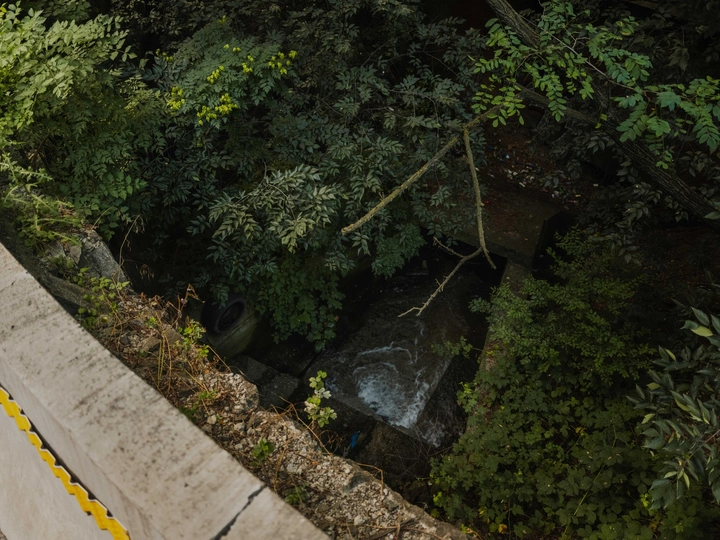
The project began with an encounter with one of these hidden rivers: a place where water could no longer be seen, only heard beneath the ground. This raised a fundamental question: how can architecture reveal invisible landscapes and reconnect people with the ecological systems that continue to exist beneath the city?
Architecture should not only create new landscapes-it should reveal the ones that already exist but have disappeared from perception. Rather than treating buried rivers as forgotten infrastructure, the project approaches them as ecological networks, cultural memories, and potential public resources.
The project develops a methodology for revealing hidden ecologies through mapping, site-specific interventions, selective daylighting strategies, and climate-responsive public spaces. These tools aim to make invisible water systems perceptible again while creating new connections between urban life, history, and natural processes.
The Avanaantkhevi River serves as a case study. Flowing beneath Liberty Square before reaching the Mtkvari River, it represents one of Tbilisi’s oldest hidden waterways.
In a time of climate change and growing ecological awareness, hidden landscapes can become catalysts for more resilient urban transformation. Rather than restoring rivers alone, the project seeks to restore a way of seeing the city as a living landscape where natural systems, cultural memory, and public life remain interconnected. Although rooted in Tbilisi, the methodology applies to European cities where rivers have been buried, neglected, or transformed into infrastructure.