Beton, Wald und Himmel
I am a research-based designer exploring the relationships between landscapes, ecosystems, and the systems that shape them. Through field research, observation, conversations, and making, I investigate how hidden histories, ecological processes, and human interventions become entangled with the environments around us.
Rather than proposing new objects, I am interested in revealing what already exists but often goes unnoticed. My projects take different forms, including installations, hikes, material explorations, objects, and publications, but are all rooted in a curiosity for understanding places and systems before intervening.
I enjoy working across disciplines and adapting my methods to different contexts, always with the aim of shifting perspectives and encouraging people to engage more carefully, critically, and curiously with the world around them.
With Beton, Himmel und Wald Paula Schulte proposes a hike along the post-war landscape of the Westwall using perceptual tools that reveal its different layers.
In western Germany, one of the largest remnants of the 2nd World War is the Westwall, a defensive line constructed during the National Socialist period in the late 1930s stretching along Germany's western frontier. Today, many concrete remnants remain scattered across the region. Interviews with experts and field research revealed the deep entanglement of this land with violence: how the landscape was treated as a resource and how vegetation was militarised to hide these structures. This violence becomes less visible as vegetation gradually grows over the concrete, reshaping how the landscape is perceived.
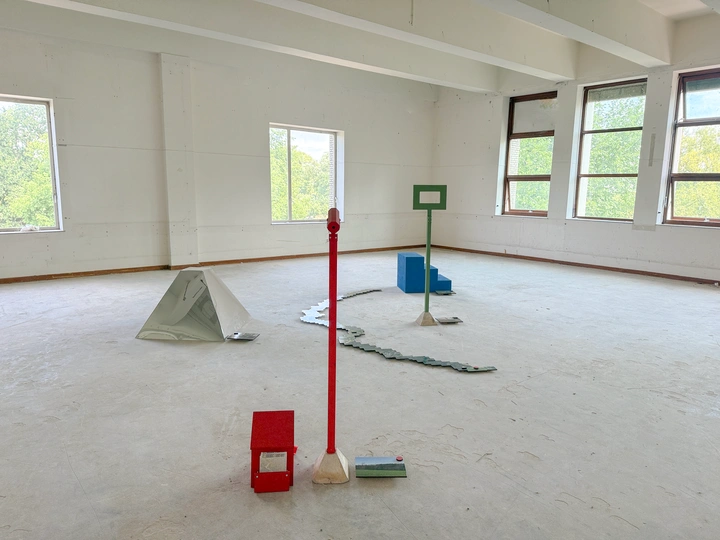
Paula Schulte proposes a hike along the Westwall structured through four perceptual tools connected through a map. Each tool reveals another layer of the landscape following the elements of concrete, forest and sky.
The path begins with monoculars that zoom in on hidden concrete structures within the vegetation. The second tool recreates the form of a concrete structure in mirror, confronting visitors with their own image within the landscape. A wooden frame follows, questioning our tendency to perceive landscape as an image rather than as a complex and living environment. Finally, a wooden staircase invites visitors to climb above the land's floor, shifting their perspective while creating a sense of exposure.
The hike reveals traces of violence that have become obscured by vegetation and time. Rather than offering a single reading, it approaches the landscape as a terrain where histories, perceptions, and realities remain entangled.
In the future, the methodology developed through this project could be applied to other landscapes where different histories, ecological processes, and human interventions overlap, using walking and perceptual tools to reveal the layers embedded within them.