Cloud Factories: Reimagining Peripheral Landscapes
Livio Liechti
Papertrail is an experimental publishing platform composed of Apsara Flury, a graphic designer, and Livio Liechti, a researcher. Our practice engages with hidden infrastructural systems and their effects on visual culture and discursive practices.
Our research spans multiple sites and temporalities, ranging from counter mapping interventions and more-than-human encounters with rural areas being transformed into AI data centres to place-based urban experiments with post-digital knowledge production and circulation.
Grounded in walking-based artistic research bridging across urban and peripheral spaces, Papertrail publishes posters, zines and long-form books, facilitates walkshops and infrastructure tours, and develops artistic interventions that make visible the everydayness of (communications) infrastructures. Through publishing interventions of varying scale and materialities, Papertrail aims to shift dominant infrastructural paradigms towards alternative, regenerative ways of knowing and seeing.
Apsara Flury’s design practice spans both autonomous artistic work and commissions for external clients, where she develops visual concepts and design outputs that attract attention to projects and organisations across varying scales, media and fields, including architecture, arts and culture. Apsara’s work has been deemed “excellent” by the Tokyo Type Directors Club and highly rated and awarded by design competitions, including Best Dutch Book Designs, INTL International and D&AD.
Livio Liechti is a researcher focused on the materiality of information infrastructures and participative forms of reshaping and reimagining public spaces. He is an incoming PhD Researcher in Planning Theory and Artistic Methods at RWTH Aachen. Livio is also active in the data centre resistance movement, where he regularly takes people on educational walks to prospective data centre sites and other infrastructural artefacts hidden in plain sight.
Cloud Factories is an ongoing artistic research and publishing project concerned with the transformation of rural and post-industrial peripheries into computational sacrifice zones. The project investigates the spatial and socio-environmental consequences of the Europe-wide construction boom of hyperscale data centres and explores ways of resisting these dynamics through alternative future-making.
The supposed immateriality of the Cloud has long been debunked. And yet, the full scale of its material and energetic entanglements tends to remain in the shadows, despite hiding in plain sight. Fuelled by the hype and fear-of-missing-out surrounding the mass rollout of generative AI, oversized data processing facilities are overgrowing peripheral landscapes like mushrooms. Our project explores how the growing resistance against these infrastructures can be turned into a generative force for peripheral renewal.
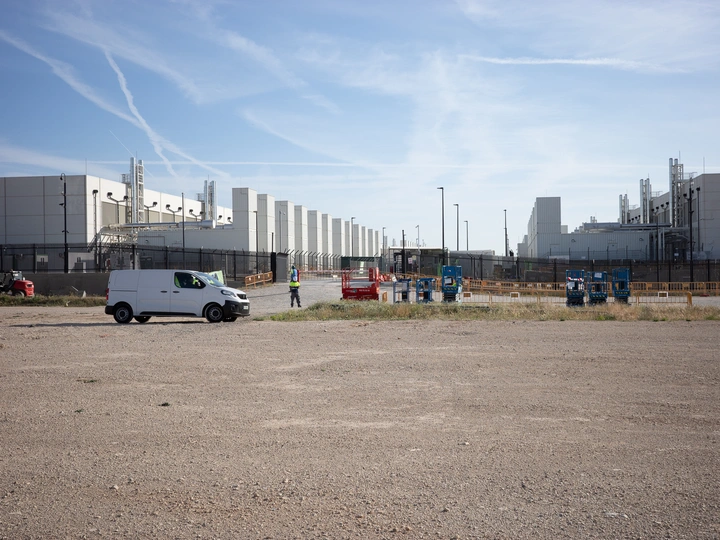
Cloud Factories started off with a comparative field study of two rural landscapes selected as prospective data centre sites – an artificial island in the Netherlands and a fire-scarred slope in Central Spain. Since then, our research has expanded to other locations and temporalities, such as post-industrial plots at the urban periphery, live construction sites and already operational facilities. By making the spatial and environmental imprint of these megainfrastructures visible through publications and exhibitions, the project aims to challenge the perceived inevitability of these developments.
Going forward, we are keen to move from a mode of documenting and critiquing to facilitating processes that explore alternative peripheral futures through discursive engagement. Together with architects, designers and thinkers, and in dialogue with the broader public, we plan to explore how peripheral visibility can nurture alternative spatial visions for ‘empty’ landscapes being sold off to the highest bidder instead of serving the public interest.