ATTACHED OTHERWISE
Merve Sahin
space.a.tonal is an architectural research and design practice based in Vienna. The studio investigates architecture through material research, adaptive reuse and context-based design. It combines theoretical inquiry with practical experience in transforming existing buildings. Working across installations, critical writing, digital fabrication and architectural design, space.a.tonal develops spatial scenarios that respond to ecological, cultural and territorial change. A particular focus lies on reinterpreting altered terrains and existing structures through adaptive reuse. The studio is currently developing architectural prototypes that translate experimental research into spatial practice, using built interventions to test, refine and communicate architectural ideas.
Merve Sahin is an architect and researcher based in Vienna. Her practice spans installations, material experimentation, and architectural research. Her graduation project was a finalist for the Mies Young Talent Architecture Award and was exhibited at the Venice Architecture Biennale. She has received grants and residencies from organisations across Europe. She is currently an artist-in-residence in Venice, researching the shifting boundaries between water, sediment, and architecture through material studies of the lagoon. Her work brings together architecture, ecology, and material research through interdisciplinary collaborations.
Daghan Dizdaroglu is an architect based in Vienna. His work spans adaptive reuse, heritage conservation and architectural research. Currently, he works as an architect and project manager at WIR Architektur, focusing on the sustainable restoration and transformation of Vienna's existing rooftop extensions. Alongside his professional practice, he develops an independent research project investigating the adaptive reuse of former wartime relics in Vienna, exploring how obsolete military structures can be transformed into new forms of public and cultural infrastructure.
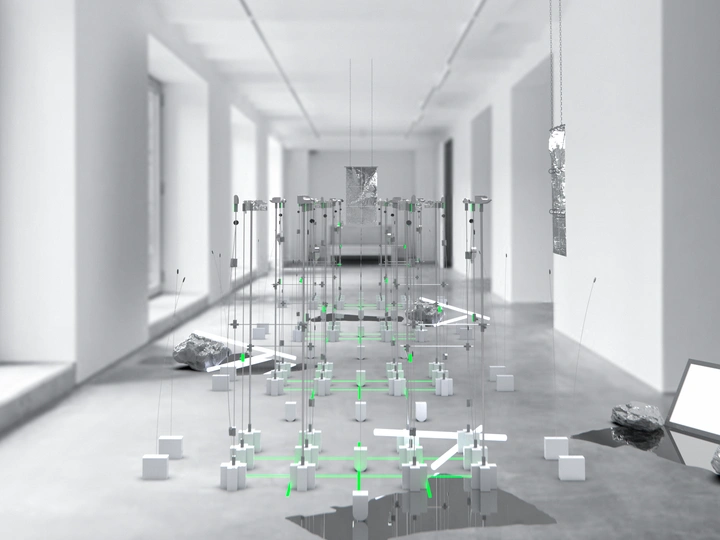
<Attached Otherwise> investigates architecture as a geological practice. Architecture participates in environmental and economic systems through extraction and resource economies. Stone, soil and minerals are displaced, yet these material processes rarely remain part of architectural thinking. The project asks what responsibility architecture has after extraction and what spatial actions can emerge from this condition.
The research begins in Salzburg, where a former quarry became a theatre.This existing condition inspires the project's first case study before expanding to quarries and post-industrial landscapes across Europe.It records cuts, blast faces, exposed strata and displaced material as traces of extraction. Rather than treating terrain as a resource, the project approaches it as an active field that records time, labour and material decay.
These sites become the basis for <Future Fossils>. Geological fragments and excavation sites are documented, 3D-scanned and translated into architectural scenarios.They are prototypes for new spatial actions after extraction that propose futures for both (I) excavated terrain and (II) material removed from it.
Excavated land becomes public forums, cultural infrastructure and places of assembly. Extracted material remains in local circulation through local re-use, rather than disappearing into anonymous supply chains. Thus, an invisible economic and material cycle becomes visible and tangible.
Publications and workshops extend the research into different contexts. Participants investigate extraction sites through mapping, collecting and making. They develop spatial and territorial studies and discuss how architecture might remain <attached otherwise> to the landscape from which it emerges.
<Attached Otherwise> proposes new spatial futures for excavated landscapes and extracted matter. It reconnects architecture with its geological origins, making this relationship visible as a spatial and territorial condition.