The Seasonal Envelope
Xixi Sun
Blas Office was founded by Vladimir Balasanyan (Architect HMONP, DNSAP) and Xixi Sun (Architect D.E.), who met while studying architecture in Paris. After working in several established architecture offices, they started the practice, working across architecture, art and landscape. Their projects emerge through an engagement with the material realities of each context, drawing on available techniques, resources, and interdisciplinary collaborations. Rather than producing fixed objects, they approach architecture as an open framework that responds to changing environments and evolving ways of inhabiting.
Recent work has been recognized with a Special Mention at Europan 18 for the Open Frame proposal (Getafe, 2025) and Third Prize in the 10th Blind Walls International Ideas Competition for Living Screen, organized by the Fundació Mies van der Rohe and the Barcelona City Council (2024). Vladimir currently teaches architectural representation at the École des Ponts et Chaussées and lectured at ENSA Paris-Belleville in 2023.
Buildings are generally designed for permanent use. Yet temporary occupation and incremental transformation have become increasingly common across metropolitan and suburban contexts. Artists, cultural institutions and local communities often work in buildings that cannot yet be permanently altered. In Noisy-le-Sec, on the outskirts of Paris, an artist’s studio became the ground for this practice.
Through temporary spatial practices, space shifts from a finished object to an evolving condition. Insulating, heating, partitioning, cleaning and repairing become ways of working with the building rather than permanently transforming it. Rapid, low-cost and reversible, these everyday acts respond to changing seasons, patterns of occupation and daily needs. They continually reshape the relationship between architecture, climate, materials and use.
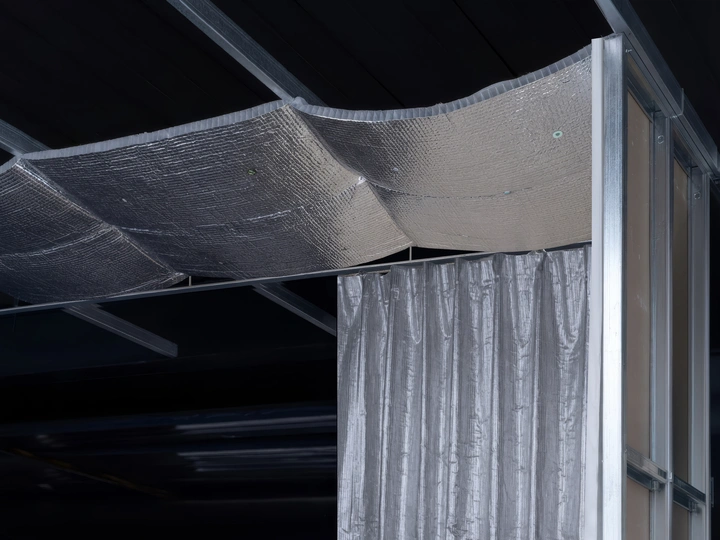
Working with the existing condition, glass wool insulation, polycarbonate panels, support structures and insulated textile curtains form another kind of envelope. Layers are added where heat is needed, removed when seasons change and rearranged as programmes evolve. The envelope is no longer a fixed boundary but something that grows, contracts and adapts over time.
The building envelope is never finished. We return to overlooked practices of seasonal adaptation, asking how temporary layers might allow buildings to adapt once again to time, climate and occupation.