Changing Room: Infrastructural Acts of Publicness
Adrián Maldonado
Eero Schoch
Kaito Yamamoto-Ran
Somin Yoo
Jack Zhang
SOMIN YOO is an architectural designer, curator, and artist working across the United States and Switzerland. Their work examines spatial and infrastructural politics. They have practiced at Christ & Gantenbein, Barkow Leibinger, and Neri&Hu, and co-founded Accessible Objects, a curatorial platform for emerging design. Somin holds a BA in Art History from Yale University and is a 2028 MArch I candidate at the Harvard Graduate School of Design, where they received the 2025 Araldo Cossutta Prize for Design Excellence.
KAITO YAMAMOTO-RAN is an architectural designer from Tokyo and Los Angeles whose work engages generosity and humor to transform existing spatial and social conditions. He currently works as a designer at Matière Noire, following experience at Christ & Gantenbein, Junya Ishigami + Associates, and BIG. He holds a BS in Mechanical Engineering and Architecture from Brown University and is a 2028 MArch I candidate at Harvard GSD.
ADRIÁN M. MALDONADO is a Barcelona-born architect currently working at Christ & Gantenbein in Basel, following positions at Cierto Estudio, Barcelona City Council, and Josep Ferrando Architecture. He holds Bachelor’s and Master’s degrees in Architecture from the Escola Tècnica Superior d’Arquitectura de Barcelona.
JACK ZHANG is a Beijing-born architectural designer whose experience includes Christ & Gantenbein, 3XN, and Kengo Kuma & Associates. He holds a BS in Architecture at Washington University in St. Louis and is a 2028 MArch candidate at Harvard GSD.
OSKAR EMMRICH is an architectural designer from Karlsruhe working at Christ & Gantenbein. He holds a BS in Architecture from the Karlsruhe Institute of Technology, where he is pursuing his master’s degree.
EERO SCHOCH is a Basel-based curator pursuing a BA in Art History and Philosophy at the University of Basel and working at Schaulager and Simonett & Baer. Their practice focuses on global and postcolonial art histories and infrastructural critique.
CHANGING ROOM is the first in a proposed series of infrastructural acts of publicness: minor redirections of existing resources toward collective use.
Developed for After Hours, a June 2026 exhibition staged in a 1954 villa above the Rhine in Basel before its demolition, the project sat at the edge of a territorial contradiction. The riverbank below was public, but every route to it crossed private property. Working opportunistically, we transformed one room in the villa into a temporary public amenity: a changing room for river swimmers. Non-structural material was dismantled, the facade opened towards the river, and plumbing adapted into a shower and sink for public use.
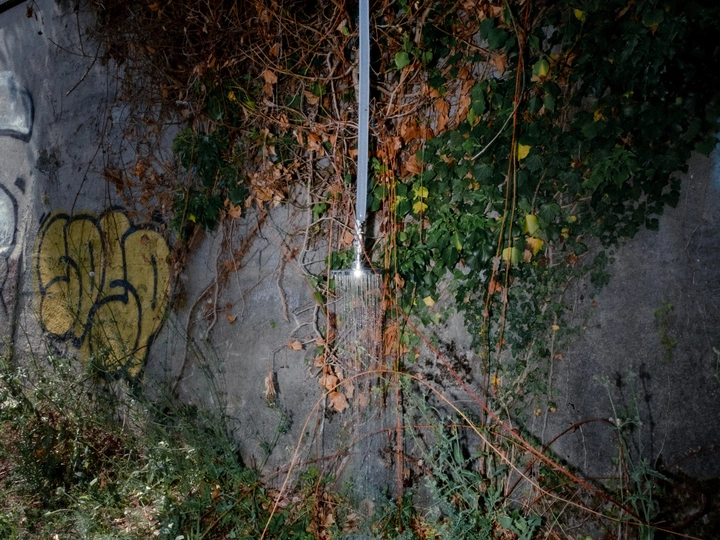
During construction, however, the shared path from the villa to the river was deliberately obstructed by a neighboring owner. Following unsuccessful mediation attempts, the project left the room: a 40-meter tube extended the villa’s water line over a retaining wall to a shower operated from the beach below. The intervention neither restored access nor resolved the conflict between public land and private ownership. It bypassed it infrastructurally.
For us, infrastructure is a means of producing publicness. Buildings contain capacities—water, energy, shelter, sanitation, storage, circulation—that exceed their assigned use yet remain enclosed by ownership, redundancy, or abandonment. Architecture can act on this discrepancy by identifying underuse or inaccessibility and performing radical acts of reorganization or redirection.
We hope to test this operation with LINA members in other sites and institutional contexts. Each case would begin with a mismatch between available capacity and restricted use, then proceed through research, negotiation, and in-situ build. The aim is not to reproduce the Basel work, but to develop architectural acts ranging from temporary installation to long-term civic interventions, creating tangible public consequences through minimal means.