Filming the City: Summer School with Beka & Lemoine
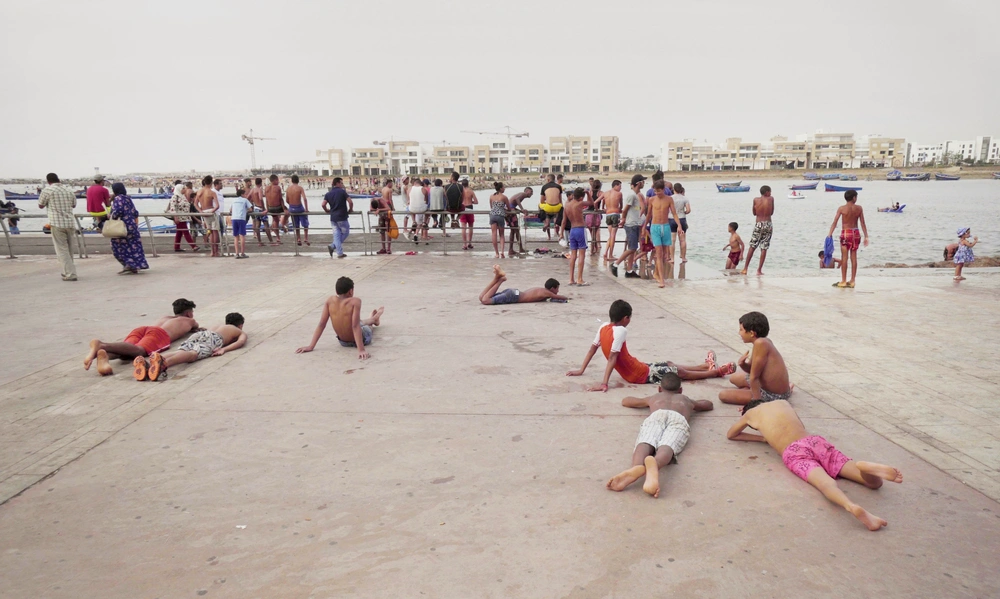
The S AM’s summer 2023 exhibition ‘Homo Urbanus: A Citymatographic Odyssey by Bêka & Lemoine’ examined the relationship of people to public space through a filmic investigation of ten global cities. With the support of LINA, a European network of architectural institutions, the S AM organized a week-long summer film workshop that applies these methodologies to the local context: Basel. Directed by Ila Bêka and Louise Lemoine of Bêka & Lemoine, this workshop held in English focused on the potential of the filmic medium in articulating alternative identities for the city, one based less on representative images and monuments, but rather the everyday actions and movements of its inhabitants.
The workshop’s main emphasis was on the quality and relevance of ideas and a unique point of view. In other words, innovative and thought-provoking positions were to be the focus, instead of a search for technical and aesthetic perfection. Technique was seen as a tool – not a goal. Over the course of five days, 11 participants (including two LINA Fellows) gained exposure to basic concepts of film technique and theory as applied to architecture and the city. Following a crash- course on representative approaches to architecture on film, participants dove into the production phase, identifying sites in Basel to work on, developing scripts, filming, editing, and undertaking post production in quick succession.The final output of the workshop was a short (ca. 3 min) film representing a personal, sharp, and critical interpretation of the relationship that Basel has developed with its river. On the evening of the final day, all the works produced were presented in the form of a miniature film festival.
The workshop was augmented by a series of theoretical inputs in the form of lectures and presentations by Beka & Lemoine and visiting LINA Fellows from outside of Switzerland.
Activity Goals
This activity’s objectives were two-fold. On the one hand, the summer school aimed to promote the LINA platform within the Swiss context by creating a high-quality, accessible program aimed at younger and emerging practitioners. A number of high-profile and public-facing events, including a lecture and screening by Beka & Lemoine and a presentation by LINA Fellows of their own work, further served to raise awareness of LINA and its activities in a wider audience.
For the LINA Fellows, the activity was meant to be an opportunity to further develop their skills and experience with the filmic medium, widen their network through close collaboration with an internationally renowned practitioner (Bêka & Lemoine), and present their own work in an informal, public-facing format.
Outcomes and Reflections
The summer school was, in many ways, an experiment for the S AM, which has lacked the personal and financial resources to produce summer workshops of this scale for adults in the past. The LINA program provided us with the means to take a chance at developing new innovative formats, focusing in particular on the use of new media to engage and visualize urban space. The participants in the summer school were more diverse than we were expecting. We had initially expected the target audience to be students of architecture and related disciplines; while this was still the largest segment of the group, other participants included freelance architects, video artists, and even an instructor for design at a local university.
The feedback from the participants was positive across the board. Many commented that it was rare for a workshop of this sort to be offered 1) free of charge, 2) without requirements on previous experience, 3) open to all age groups (and moreover not affiliated with an educational institution), and 4) provide opportunity forclose contact with high-profile instructors. The participants also positively evaluated the variety of different inputs (the lectures by LINA fellows and the instructors) provided during the course of the week, which helped to break up the intensity of the workshop and encouraged camaraderie between participants.
The LINA Fellows appreciated the opportunity to further their work by gaining experience with the filmic medium as a way to narrativize space (both groups engage with storytelling in their own practices, but film was something new for them), as well as the chance to present their activities in a casual, collegial atmosphere.
Related fellows