Culture in Residency: Adaptive Reuse and Material Experimentation
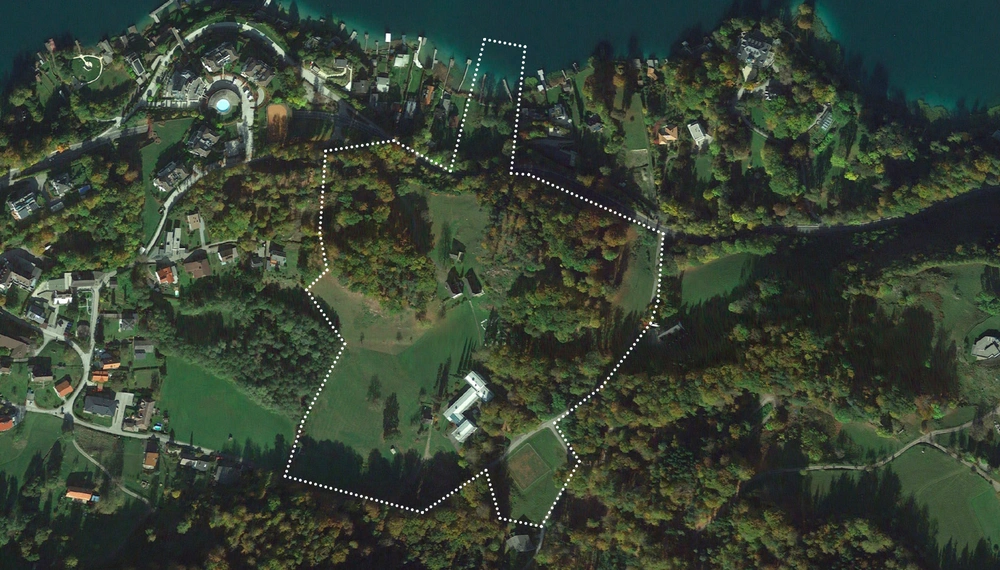
In the first year we are working on a very clear agenda, namely the development of scenarios for the future development of a ‘Ferienheim’ for the Vienna Boys’ Choir on a piece of land on Lake Wörthersee in Sekirn, Carinthia, which serves as a testing ground for us.
We believe that it is an ideal situation, as there is already an existing ambition, a common goal, but still many open questions and space for experimentation, in which LINA fellows can contribute their own existing ideas, research.
Culture in Residency: Material Library
LINA fellows are invited to lead a hands-on workshop that explores experimental regenerative design practices using locally-specific materials – such as earth and wood – found in the region of Wörthersee.
Known for its prominence among Austrian lakes, Wörthersee has 83% of its shores locked by private developments. One of the remaining plots with potential public access to the lake is the Vienna Boys Choir campus located in Sekirn, Wörthersee.
The 8 hectares plot is used by the choir in the summers while the rest of the year it remains unused. Their ambition is to keep the plot for future generations of the choir as well as to open it up to the general public for all-year round cultural activities.
The slowly deteriorating existing buildings on site offer a testing ground for radical strategies of adaptive reuse through local resources and material waste streams.
January 2023: Fellows presented their ongoing research at a public lecture at TU Vienna.
April 2023: Fellows participated in an excursion to Atelier LUMA, LUMA Arles (FR).
May 2023: Fellows developed and led a 10 days Hands-On Workshop in Sekirn with students from TU Vienna
Field trip
In the initial phase of the project, several meetings took place between TU Wien staff (Prof. Tina Gregoric, Thomas Amann and Jakob Travnik) and LINA fellows Charly Blödel and Estelle Jullian to discuss possible focal points for the workshop.
How can the fellows’ individual interests and research topics find a place in the project? What focal points arise from the conditions of the location and its spatial and social characteristics? What should students learn during the workshop?
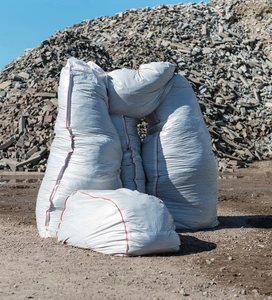
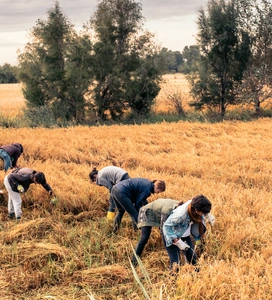
During a joint excursion to Sekirn it was important to understand the site, the region and the local contexts in order to further specify the project. An extended tour of the site and its neighborhood took place, as well as a tour of various companies (quarries, wood processing, agriculture) to understand local material cycles and waste streams and to establish initial contacts with potential partners.
- What resources are to be found locally?
- Which materials and which competences are existing in the region and should be better utilized and connected?
- Which partners could become part of the project?
Concept and presentation
In the second phase of the project, the program was defined more precisely and formulated in the form of a text. At the start of the semester in March, the workshop was publicly presented at TU Wien and subsequently introduced in more detail to interested students.
Public lecture at TU Vienna
On March 16, a public lecture was held at the TU Vienna, where Charly Blödel and Estelle Jullian presented their previous projects and research work, followed by a discussion with LINA fellows Bernadette Krejs and Max Utech (both also TU Vienna staff). What are the roles & responsibilites of young spatial practitioners in the future?
- How can we overcome preconceived concepts and methodologies in teaching?
- How can we support exchange between young practitioners, between academia and practice?
- How can we learn from and interact with each other?
The lecture was recorded and made available on youtube: LINK
Excursion to Atelier LUMA
At the end of March, an excursion to LINA member Atelier LUMA, Arles took place with 40 students as well as teachers from TU Wien, in which LINA fellows Charly Blödel and Estelle Jullian also
participated.
After a detailed presentation of the different activities of Atelier LUMA, they reflected together on the current TUW project “Culture in Residency: Material Library”.
On the second day, a guided tour of the grounds and premises of the LUMA Foundation and Atelier LUMA took place, during which the various material applications were presented.
Hands-on Workshop
In 10 days in May, Charly Blödel and Estelle Jullian worked with a group of 14 students to experimentally produce specific recipes from local resources, waste and by-products in the form of material samples for wall elements, bricks, plaster, panels and dyes.
At the beginning, they went on a tour through the area and to different companies in the region to get to know their production methods and processes and to learn from their knowledge. Besides the concrete work on samples, the understanding of local contexts, existing potentials and actors was an important learning goal.
The final output suggests alternative material narratives, potential development opportunities and above all the establishment and strengthening of a local network of resources, actors and knowledge. On 31 May, the results were presented and discussed in front of an international jury and all partners from the region and made accessible for the future in the form of a material library.
Related fellows