Staging Ground
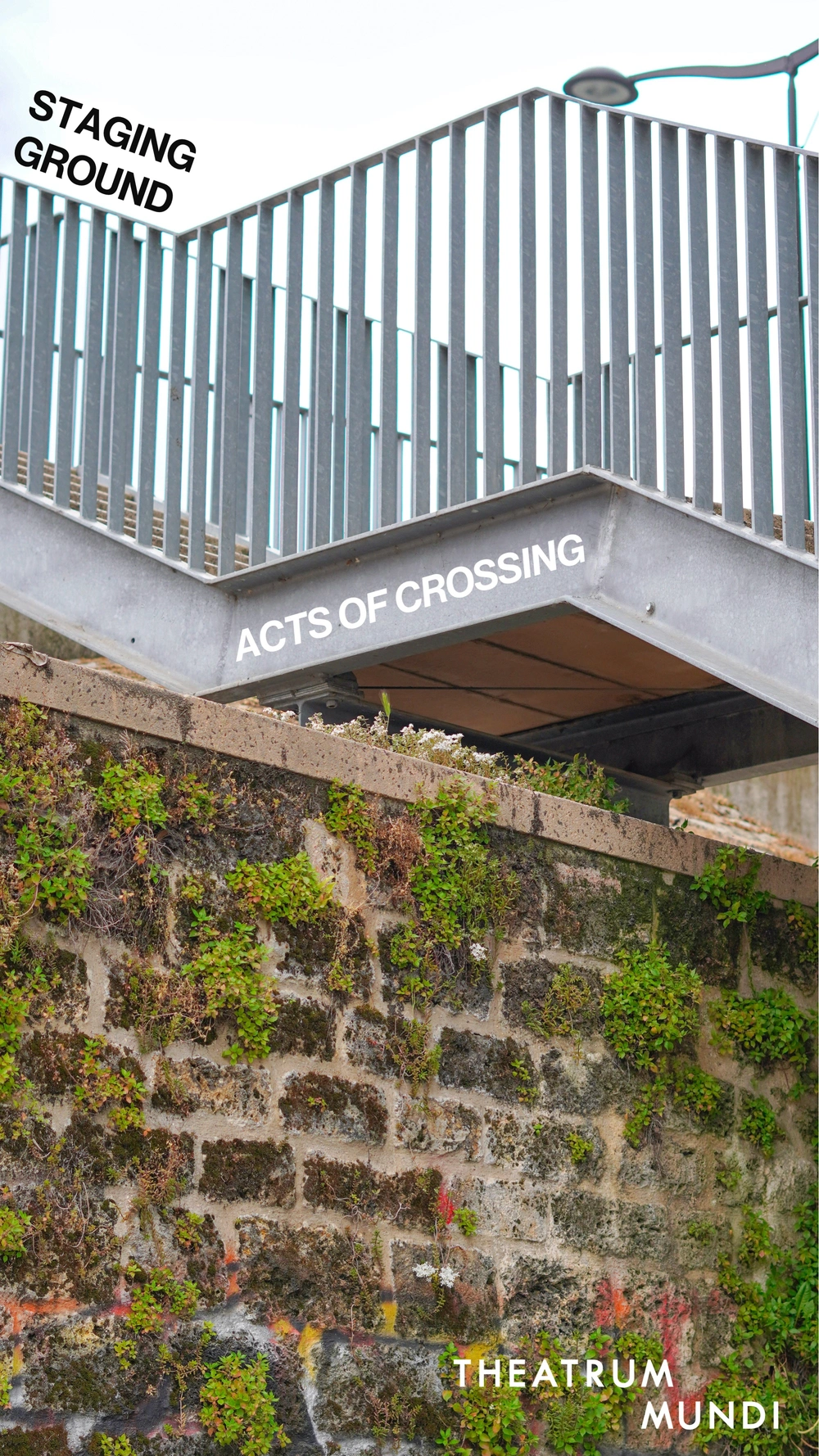
Staging Ground is a platform for performative responses to urban challenges. The 2023
cycle "Acts of Crossing" invited emerging practitioners to develop critical documentations
of questions of mobility and its (in)justices around the Boulevard Périphérique, the ring road
encircling Paris. Often perceived as a barrier between Paris and surrounding suburban
communities, the Périphérique is also a crucial infrastructure connecting suburbs that suffer
from lack of public transport. Competing visions for the future of the Périphérique, how to
overcome the barriers it creates and reduce its environmental impact, are hotly contested
– from the introduction of walking and cycling lanes to its wholesale demolition. The three
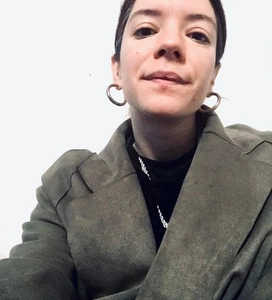
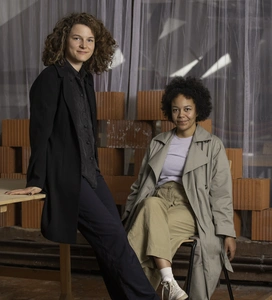
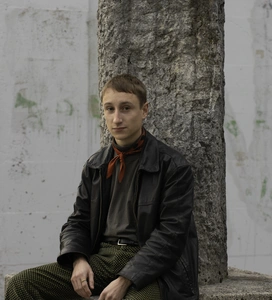
LINA Fellows participating in Staging Ground were introduced to performance-based urban
research tools, enabling them to develop their own practice by exploring what it means to
cross the Périphérique. Their projects explore creative methodologies for imagining,
experiencing and designing mobility transformations from diverse embodied perspectives.
Format
The residency took place in two stages in spring. In March, LINA fellowa took part in a research week including a programme of walks and discussions bringing visiting them into contact with local artists, urbanists, and active citizens. In April, a production week gave the opportunity to collect documentation and test actions on the ground. The week ended with a public presentation of work in progress. In autumn, the outcomes of the fellows' work will be published on a dedicated project website in the form of film, sound, and cartography. The website will build up through the course of the three-year LINA programme, as an archive of performance-based methodologies for testing ecological transitions.
Staging Ground is an activation of the ideas developed within Movement Forum, Theatrum Mundi's 2021 programme of experimental laboratories in London, Paris and Lisbon, as part of Future Architecture Platform, exploring movement practices in response to mobility injustices of gender, sexuality, age, and ecology. The residency programme was announced in a public event in Lisbon in October 2022, as part of the Lisbon Architecture Triennial. The event included a launch of the publication resulting from the Movement Forum programme, with a panel exploring how it can inform new performance-based urban research practices, as well as a day of workshops testing ideas for the residency with the choreographer Rafael Alvarez and urbanist Takako Hasegawa.
Programme activities
Launch event
The event Three Parties in Wonderland acted as both a conclusion to Theatrum Mundi’s 2021 Future Architecture Programme (FAP), and a launch of the new Staging Ground platform. It was organized in partnership with Lisbon Architecture Triennial and À la sauvette (2021 FAP Fellows) with support from the Institut Français and Instituto Camoes, as part of Terra, the 2022 Trienal de Lisboa, and the Saison Croisée France-Portugal. It was the key public-facing activity of our 2022-23 LINA programme, with communication support from the Triennale programme and an audience of around 70 people throughout the day.
The programme was organized as follow:
• Act 1 Care: Workshop - Takako Hasegawa (Architect)
How can new forms of interdisciplinarity between city-making and dance-making help engender care for bodies in space? Takako Hasegawa opened up our perceptions to different bodies and experiences in relation to the city. The workshop was attended by around 25 participants including local residents as well as amateur dancers aged over 55 from Paris and Lisbon, part of a group animated by Rafael Alvarez.
• Act 2 Body Maps: Workshop - Rafael Alvarez (Choreographer)
How do our bodies relate to the objects around them, and how do we navigate all of these micro relationships? Rafael Alvarez sees the body as a map, as a possibility to travel, to come together and to isolate oneself. All participants from the first workshop stayed to participate in the second workshop.
Act 3 Wonderland: Screening/Installation/Book Launch - Theatrum Mundi & À la sauvette
The film “Topographies of Body and Landscape” (2022) documents the choreographic movement research and spatial observation experiments that took place during Theatrum Mundi’s Movement Lisbon Lab in October 2021. Produced by Metafilmes and directed by Vítor Hugo Costa.
The book “Encounters” from TM Edition was also launched with a panel including the editors Fani Kostourou and Elahe Karimnia, invited respondent Meriem Chabani (2023 LINA Fellow), and contributor John Bingham-Hall. Finally, an art installation and DJ set organized by À la sauvette collective was set up with the aim to challenge our embodied relationship with collective celebrations and physical space.
Research week
This first residency week was designed to introduce the residents with the different themes and locations addressed by the residency. The programme included workshops, walks and presentations with contributors from different disciplines and domains. It was also an opportunity for residents to receive information and tools in view of preparing their respective research projects. The
residency was based at Les Arches Citoyennes, a temporary workspace and emergency housing complex operated by Plateau Urbain. As well as the presentations and screening taking place there, LINA Fellows had access to the workspace and Theatrum Mundi’s library of publications all week, and came into contact with the community of non-profits, small businesses and artists working there. At the end of the week, the residents were able to receive feedback from two of the mentors in preparation of the second production week.
The programme was organized as follows:
• Presentation : Magda Maaoui (Atelier Parisien d'Urbanisme)
This session was particularly useful for the residents to have a historical background on the Boulevard Péripherique as well as a critical understanding of the politics of this space. The presentation included different cartographies of Boulevard Péripherique to highlight the numerous ways to analyze it. One example showed how the ring road goes underground and disappears in the wealthier neighborhoods and reappears above ground in poorer areas.
• Presentation : Martin Glichitch, Dominique Rascol, Thibault Lemaitre Ntoni (Plaine
Commune)
The idea for this presentation was to introduce the residents to the different issues around urban mobility and the Boulevard Péripherique from a policy perspective. The discussion also centered on how this infrastructure may be transformed in the future to adapt to questions regarding pollution, livability and clean mobility.
Workshop: Alexandra Lacroix (Playwriter and Director)
Moving away from the presentation format, the residents were able to reconsider ideas about the urban space through a movement workshop. The main exercise consisted of participants navigating the Chapelle Charbon Park in northern Paris blindfolded in order to create mental maps. In this sense, the idea was to foreground sound and hapticity as potential alternatives to experience the urban space around us.
Workshop: Fani Kostourou (Central Saint Martins/ Grimshaw Architects)
Fani introduced Fellows to diverse approaches of cartography, and critical issues around representation and positionality in mapping practices. The fellows then tested these approaches around the Périphérique, informing their tools for documenting the infastructure and its uses.
Walk: John Bingham-Hall (Theatrum Mundi)
The idea of the walk was to explore the place of nature and non-human actors around the Boulevard Péripherique. Despite being a seemingly an inhospitable environment, what opportunities are there for new ecological connections. The walk included a visit to the “linear forest” located on both sides of the ring road.
• Presentation: Ghassan Salameh (Curator and Independent Consultant)
Ghassan opened a discussion about positionality and the relationship between a researcher and a community in which they are an ‘outsider’. He presented his work facilitating a community in Beirut to develop activist responses to issues of noise and commercial development affecting their everyday lives, informing conversations about noise as an issue for the Périphérique, and how to develop grassroots responses.
Film Screening: Choreographing the City (Theatrum Mundi, 2019) and Topographies of Body and Landscape (Theatrum Mundi, 2022)
The film screening provided an opportunity for the residents and other attendees to look back at Theatrum Mundi’s projects concerning choreographic thinking and methods and urbanism. As well as the residency participants, the screening was attended by Tevi Allan Mensah (LINA fellow) and other residents of the Arches Citoyennes workspace working on urbanism and mobility.
Walk/Workshop: Rafael Alvarez (Choreographer)
The last activity of the week took place in the form of a collective walk across the Boulevard
Péripherique followed by a movement workshop, which included the residents as well as external participants. The idea of the workshop was to interpret through movement the experience of having walked across the ring road.
Production week
This second residency week was designed to provide the residents with time and resources to implement their residency projects on site. As organizers, our support was two-fold: we provided logistical support as well as critical feedback on the content of their projects. Amongst the three residents, one of them was not able to attend the production week. However, Theatrum Mundi provided support from a distance for the implementation of their project.
During the week, one of the residents also organized a public workshop attended by nine participants, including young architects and participants in Rafael Alvarez’ dance group, who had also been present at the launch event in Lisbon. Inspired by the ideas of Bruno Latour, the workshop aimed at thinking about the different connections between human and non-human actors in and around the ring road.
Finally, a public presentation of the resident’s projects was organized in the Villa Dyonisos, a new cultural space located in the city of Saint-Denis. The event took the form of an informal discussion between residents and attendees as well as a dialogue between two mentors of the programme, Magda Maaoui and Lamyne M. This was an opportunity for residents to also receive feedback on their ongoing projects before final publication on the project platform.
As well as local residents and cultural actors, there were representatives of Forecast Platform (Berlin), the Institut Français, and LINA.
Conclusion and future plans
One of the main goals of the residency was to consider the question of urban mobility in the context of the Boulevard Periphérique from a diversity of perspectives and disciplines to provide innovative ideas. The concept of the residency was specifically built upon previously explored ideas on the relationship between body movement, choreography and the urban environment. Some of the key themes discussed during the two-week residency included: ending spatial segregation, the importance of care-centered politics, thinking about the connectedness between human and non-human actors. Next year, we plan to evolve the residency focus by going beyond the Boulevard Périphérique to look and mobility transformations across the territory of Plaine Commune, a new administrative area taking in Saint-Denis and surrounding communes. In the presentation by members of the Plaine Commune urban planning team, we learned how motorway infrastructures across the area were being seen as a challenge, but also as a spatial disruption creating opportunities for new kinds of green and social infrastructure. We also heard about an initiative introducing temporary, playful interventions into newly pedestrianized streets, and studying the impact on active travel and new uses. We plan therefore to work with Plaine Commune to direct the residency towards actions that can help imagine these transitions to more sustainable mobility cultures, as well as offering tools to critique their social implications.
Following a successful residency presentation at the brand-new cultural space Villa Dionysos, in Saint-Denis, we plan to work more with Lamyne M., the Villa’s programmer, to base the entire residency there. This will enable us to develop more close contact between the LINA Fellows and local residents in Saint-Denis, adding presentations of Fellows’ existing work to a public programme during the first residency week. Fellows will also work closely alongside masters and PhD students of EUR ArTeC, a cross-university research centre focused around creative research methods, who will also be based at Villa Dionysos.
With ArTeC we plan to deliver a summer school in July 2024, looking at how the Paris 2024 Olympic Games will drive transformations of public culture and mobility in Plaine Commune. This will be the opportunity for Fellows to present the outcomes of their residency projects. Finally, we hope to partner with the Cité Internationale des arts to offer Fellows residency accommodation as part of a global community of visiting artists and researchers.
Related fellows